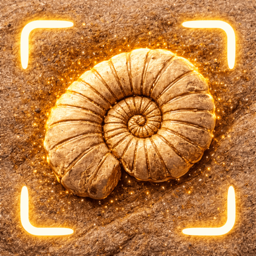
Fossils are the internet's favourite mystery object: a spiral in a rock, a tooth in the gravel, a shell-like ridge on a beach stone. A fossil identifier takes the guesswork out. Photograph your find and AI recognition compares it against known fossils to tell you what it is, how it lived, and when.
What a fossil identifier can name
The most-found fossils are more common than people expect, and the app knows them all:
- Ammonites — coiled spiral shells, the classic fossil, up to ~240 million years old.
- Trilobites — segmented, bug-like marine animals from the Paleozoic.
- Shark teeth — glossy, triangular and abundant in coastal sediments.
- Brachiopods and bivalves — clam-like shells, often mistaken for rocks.
- Corals — such as horn coral (rugose coral), with fine radiating ridges.
- Crinoids, belemnites, plant fossils and insects in amber — and much more.
How to identify a fossil with the app
Tap Identify. Photograph the fossil or upload an existing image.
Let the AI interpret it. It surveys overall morphology, traces sutures and ornamentation, and cross-references reference collections.
Read the history. Get the fossil's name, common names, geological range, habitat, feeding type and typical locations — then save it to your collection.
Identify your fossil now
Turn a mystery find into a named piece of history — free on iPhone and iPad.
Download freeIs it a fossil or just a rock?
The most common question of all. Fossils show biological structure — symmetry, ribs, chambers, teeth, or a repeating pattern — that ordinary rocks lack. If a shape looks too organised to be random, it's probably a fossil. The app makes the call for you and explains why; for the field method, read how to identify fossils.
How old is my fossil?
Once the fossil is identified, its geological range tells you the era it comes from. An ammonite places you in the Mesozoic; a trilobite, the Paleozoic; a horn coral, somewhere between the Ordovician and Permian — roughly 250 to 490 million years ago. The app shows this range with every result.
Tips for a clean fossil scan
- Photograph the most detailed face — the side that shows structure.
- Use raking side light to bring out ridges and sutures.
- Gently brush off loose dirt; don't scrub away detail.
- Include the whole specimen in frame, then a close-up of the key feature.
Frequently asked
Is the fossil identifier free?
Yes — free to download and try, rated 4+, in 33 languages, with optional unlimited scans.
Can it identify a shark tooth or dinosaur fossil?
Yes. Shark teeth and many vertebrate and invertebrate fossils are recognised. Rarer finds still return the closest known match plus context.